
Self-Leadership
What if every student left your school with a personal system for leading themselves?
A system for focusing when distractions are everywhere. For responding when pressure gets loud. For recovering when something goes wrong. For setting meaningful goals—and following through when motivation fades.
That is what your students build inside Momentum Mental Toughness.
MMT is a ready-to-facilitate gamified self-leadership experience that helps students build greater awareness, direction, confidence, resilience, ownership, and intentional action—in school, activities, relationships, and life.
The story
The Short Story Behind MMT
This video was initially designed for parents of athletes; however, it is relevant for all students. This is just a 9-minute segment. If you have time for the full 17 minutes, skip to the full version below.
Or, If You Prefer — The Full Story
WHY MMT MATTERS
The Lessons Matter. Too Often, They Arrive in Pieces.
Schools already work hard to develop responsible, resilient, capable students. Teachers, counselors, coaches, and families reinforce goal-setting, confidence, leadership, good decision-making, and personal responsibility every day.
But those lessons often arrive separately—during an assembly, after a setback, inside an activity, in a conversation with a trusted adult, or when a student is already struggling. The message may be valuable, but without a shared language and connected process, it can be difficult for students to remember and use when it matters.
Growth should not depend on a student happening to find the right adult, hear the right words, or be in the right room at the right time.
A speaker can create a powerful moment. MMT gives your school a system for what happens next.
MMT connects those moments into one intentional, sequential experience—giving every student repeated opportunities to learn the tools, make them personal, practice them, and carry them into real life. Your investment does not disappear when an event ends; it builds a repeatable self-leadership process your school can reinforce over time.
HOW MMT WORKS
Growth Follows a
Repeatable Rhythm
MMT is a sequenced seven-Mission journey—not a collection of disconnected videos, activities, or motivational ideas. Each Mission builds on the work that came before it, while every lesson follows the same four-part learning rhythm:
1. Learn
A short, direct video lesson (average 5½ minutes) introduces the concept, demonstrates the tool, and explains why it matters.
2. Reflect
Students use their workbook to document and connect each lesson to their own experiences, decisions, and goals.
3. Discuss
A facilitator creates space for students to examine thinking, hear perspectives, and go deeper without prescribing answers.
4. Apply
Students choose a practical next action and use the tool beyond the lesson—then return ready to reflect, adjust, and build.
Learn it. Make it yours. Talk it through. Take it with you.
That consistency matters. Students spend less energy figuring out what they are supposed to do and more energy engaging with the work itself.
The goal is not simply to cover content. It is to help students understand a tool, practice it with purpose, and recognize when to use it in real life.
WHAT STUDENTS BUILD
Every Mission produces something students can use.
MMT is built around creation, not consumption. Students do not simply watch videos or discuss good ideas. They write, choose, map, rehearse, test, and adjust.
Across seven sequential Missions, each student develops:
A clearer picture of what shapes them
Students identify the people, activities, habits, values, and priorities influencing their decisions—and separate what they can control, influence, or release.
A future worth working toward
They create a Legacy Vision, choose a meaningful Momentum Goal, and connect it to an Ultimate Why that makes the work personal.
A plan they can actually execute
They break their goal into Milestone Markers, Action Reps, and Prep Steps, then create If–Then Plans for obstacles likely to get in the way.
Tools for high-pressure moments
They practice the Momentum Breath, Let-Go Cue, identity and performance mantras, visualization, and mental rehearsal.
A consistent practice for reflection and adjustment
They build the MMT in 3 and MMT in 5 routines, review their growth, and create a Never Settle Statement to guide what comes next.
These are not disconnected worksheets. Together, they form a personal playbook students can revisit as their goals, roles, challenges, and environments change.

The 7-Mission MMT Self-Leadership System.
The 7-Mission MMT Curriculum
The core program is a progressive, 7-mission journey. Each mission builds on the previous one, creating a layered system that strengthens both mindset and behavior.
Every mission includes short video lessons and guided workouts designed for immediate application.

Mission 1 — Momentum Warm-Up
Students learn why mental training matters and how the entire MMT system works.
They install their first daily habit — the Momentum Breath — and learn to think like an elite performer through journaling and pattern recognition.
By the end of this mission, students feel calmer, clearer, and more in control — fast.

Parent Win: You'll notice fewer emotional spikes and less resistance before practices, games, or school.
What Students Build: A simple daily reset for pausing, refocusing, and responding with greater intention.

Mission 2 — Circle of Influence
Students learn how their environment shapes their confidence and performance.
They build their Inner Circle, map their support Huddle, audit their daily activities, and learn to differentiate what they can versus what they cannot control and create If–Then plans for pressure situations.
Confidence grows when students stop leaking energy to distractions and drama.
Parent Win: You're no longer the one policing distractions. Your athlete starts noticing and adjusting on their own.
What Students Build: Greater awareness of what shapes their attention—and a practical way to direct energy toward what they can control or influence.

Mission 3 — Legacy Launchpad
Students build their Values Vault, set their Priority Picks, begin the nightly MMT in 3 reflection habit, and write their Legacy Vision — a 6-to-10-sentence snapshot of who they are becoming.
Most students drift. MMT students move with purpose, especially on hard days.
Parent Win: Conversations shift from parent-led "What do you need to do?" to athlete-led "Here's what I'm working toward."
What Students Build: A clearer sense of who they want to become and how their everyday choices connect to that vision.

Mission 4 — Goal Setting for Momentum
Students write a single, focused Momentum Goal, dig into their Ultimate Why through a 5-layer motivation drill, set three dated Milestone Markers, and build their daily Action Reps and Prep Steps.
Goals stop being wishes and start shaping daily decisions.
Parent Win: Effort becomes visible and measurable. Less guessing, fewer reminders.
What Students Build: A meaningful goal translated into measurable milestones, specific actions, and practical preparation.

Mission 5 — Prepare Your Mind for Momentum
Students identify and cut three energy leaks, create If–Then plans for their most common obstacles, build their Identity Mantra and Performance Mantra, and install mental reset tools for high-stress moments.
This is where students stop spiraling and start preparing.
Parent Win: Conversations shift from parent-led "What do you need to do?" to athlete-led "Here's what I'm working toward."
What Students Build: Personal plans and reset tools for navigating distractions, obstacles, mistakes, and pressure.
Mission 6 — Seeing Is Believing
Students build a Momentum Highlight Reel, create a Momentum Mental Movie, install a 60-second Mantra Quick Stack, and build a personal Momentum Vision Board.
Confidence becomes familiar — not borrowed.
Parent Win: Confidence shows up before the event, not just after success.
What Students Build: A mental-rehearsal practice for preparing for important moments with greater clarity, confidence, and intention.

Mission 7 — Elite Momentum
Students upgrade to the MMT in 5 Elite reflection system, build an Elite Mantra Stack, complete their Elite Reflection, write their Never Settle Statement, and choose their next growth checkpoint.
Momentum becomes a lifestyle, not a phase.
Parent Win: Ownership stays with your athlete even after the program ends. MMT skills are becoming their life skills everywhere.
What Students Build: A repeatable reflection system, a personal Never Settle Statement, and a clear next step for continued growth.

The Universal MMT Digital Workbook
A single, comprehensive digital workbook that serves as your student's personal performance playbook. It guides them through every reflection, exercise, and tool in the curriculum.
This is not a passive worksheet — it is the tangible artifact of their entire journey.
What Students Leave With: A living record of their growth—the goals they set, the tools they practiced, the progress they made, and a roadmap they can continue using long after MMT ends.
The MMT Private Community
Optional Partnership Component
Schools may choose whether student community access is included based on their implementation goals, student population, and preferred level of support.
Full access to the private, MMT online community for the duration of the Challenge.
Students share wins, post their Huddle Shares, ask questions, and get support from peers on the same journey.
The community includes a dedicated Momentum Monday weekly check-in that builds the habit of consistent action throughout the program.

The Parent’s Guide to Building Momentum
Optional Family-Support Component
Schools may choose whether student community access is included based on their implementation goals, student population, and preferred level of support.
Parents will be invited to the private, moderated MMT online community for the duration of the Challenge.
Parents share wins, ask questions, and get support from MMT Mentors and fellow parents on the same journey.
A dedicated digital guide written specifically for the parent. This is not a summary of their student's curriculum. It is a standalone resource that gives them their own clear role in the process.
It includes:
Their Role in the MMT System — what their job is, and what it isn't, during the program
Mission-by-Mission Parent Overview — what their student is learning and what behavioral changes to look for at home
The Parent Language Guide — the key MMT vocabulary so they can speak the same language as their student
Conversation Starters by Mission — specific, non-confrontational prompts that invite connection rather than interrogation
What to Do When Things Get Hard — how to navigate the moments when their student wants to quit or pushes back
The Post-Game Protocol — a simple, repeatable 5-step framework for the car ride home after a difficult performance

The MMT Measurement and Growth Reporting System
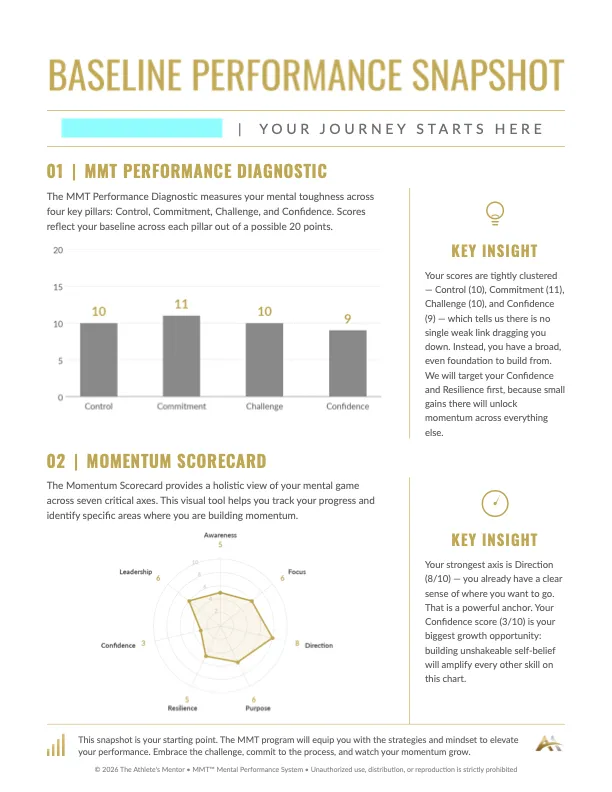
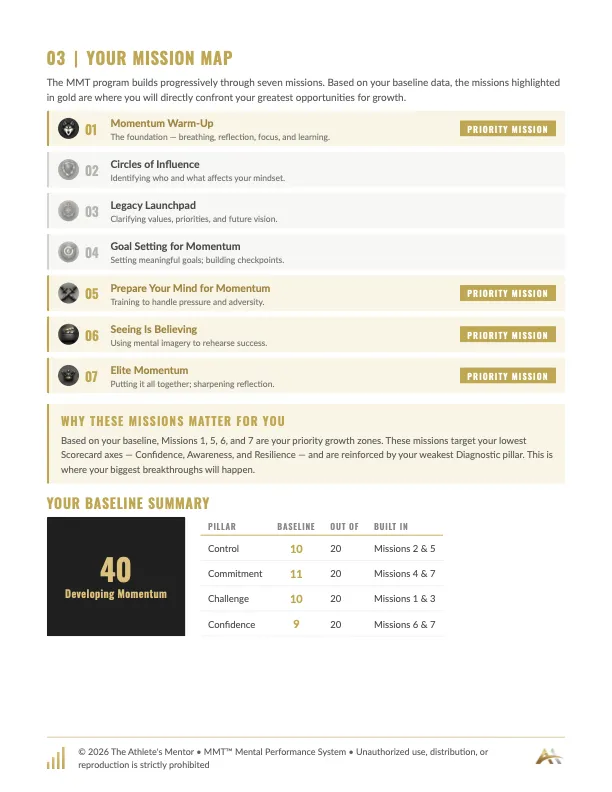
This is what makes MMT unlike anything else in the market.
Every other program asks you to trust that something is working. MMT shows you.
The Growth Report System consists of three integrated components:
The MMT Performance Diagnostic
A structured 16-question self-assessment completed at baseline, midpoint, and completion.
It measures growth across four core pillars. Students reflect across four mental-toughness pillars: Control, Commitment, Challenge, and Confidence. Each pillar is scored from 4 to 20, producing a Total Momentum Score between 16 and 80.
The MMT Momentum Scorecard
A visual, 7-axis self-assessment completed at the same three checkpoints.
Each axis corresponds to one of the seven MMT missions. Students reflect across seven Mission-aligned areas: Awareness, Focus, Direction, Purpose, Resilience, Confidence, and Leadership. Their responses create a visual picture of how they perceive their growth throughout the experience.
Individual and School-Level Growth Reporting
Students receive an individual Baseline Snapshot, Mid-Journey Checkpoint, and final Growth Report. School leaders receive aggregate school-level reporting that can support reflection, coaching conversations, and implementation decisions.
The purpose is not to label students, diagnose concerns, or reduce growth to a single score. It is to help students recognize changes in themselves and give schools a clearer picture of student-reported development over time.

The Pressure Proof Toolkit
Five downloadable, one-page quick-reference tools your students can use — before they've even started Mission 1:
The Post-Game Reset Card — A 5-step process for defusing tension after a difficult performance
The Pre-Performance Primer — A 3-step routine for the 15 minutes before any high-pressure moment
The Mistake-Recovery Protocol — A 4-step process for resetting mentally after an error
The Weekly Momentum Check-In — A one-page weekly reflection template
The MMT Core Vocabulary Card — A one-page glossary of the 15 most important terms in the MMT system
BUILT FOR SCHOOLS
A Complete System for Students
A Realistic Role for Educators
Concise by design: 37 high-impact video modules strategically built to respect instructional time while maximizing student engagement.
MMT is not a curriculum you teach. It is a system you facilitate.
Designed to fit your structure
MMT is designed to fit within structures schools already use—such as advisory, homeroom, seminar, leadership programming, activities, or a dedicated class—without asking staff to develop another curriculum from scratch. The video lessons and workbook provide the primary instruction.
Brief training videos
The videos are intentionally brief so students spend less time passively watching and more time reflecting, discussing, practicing, and applying.
Schools determine whether each component happens in the classroom, independently, or through a blended approach—and how much time to dedicate to workbook activities and discussion.
Facilitators set up for success
That does not make the educator’s role passive. With training and clear lesson-by-lesson guidance, facilitators set the standard, ask purposeful questions, clarify or re-teach tools when needed, correct misunderstandings, support practice, and help students connect the work to their lives.
They are not expected to become therapists, mental-performance experts, or the source of every answer. They guide the process while protecting student thought, choice, dignity, and ownership.
Your school shapes the implementation
Your team determines where MMT fits, how quickly students progress, who facilitates, which local examples strengthen the experience, and how established student-support and family-communication procedures remain connected to the work.
Supporting the adults who support the students
Students do not grow in isolation. The adults around them can either reinforce the work—or unintentionally turn it into another lecture, reminder, or source of pressure.
MMT supports parents alongside their students. Schools receive ready-to-send family emails that explain what students are learning, introduce the shared language and tools, and help parents encourage growth without taking ownership away from their child.
More resources for the parents
Parents also receive practical resources and access to the MMT Parent Community, giving them continued guidance as new goals, challenges, and conversations arise at home.
Schools may also arrange an optional parent assembly—MMT Support from Home—led by Cody and Teresa. This session helps families understand the MMT experience, use the tools and language at home, and support their student without becoming the manager of the process.
The complete school partnership includes:
The complete seven-Mission video curriculum
Individual student accounts and workbook access
Progress tracking, action check-offs, XP, badges, and recognition
Facilitator training and the complete MMT Facilitator Guide
Lesson prompts, implementation resources, and technical support
Launch planning and ongoing partnership support
The MMT Performance Diagnostic and Momentum Scorecard at baseline, midpoint, and completion
Individual Baseline Snapshots, Mid-Journey Checkpoints, and final Growth Reports
Aggregate school-level growth reporting
Family communication: ready-to-send MMT email series
Parent support: practical resources and MMT Parent Community access
MMT supplies the SYSTEM. Your school makes room for it to MATTER.
EXPERIENCE BEHIND THE SYSTEM
Built Through Real Work With
Real Students
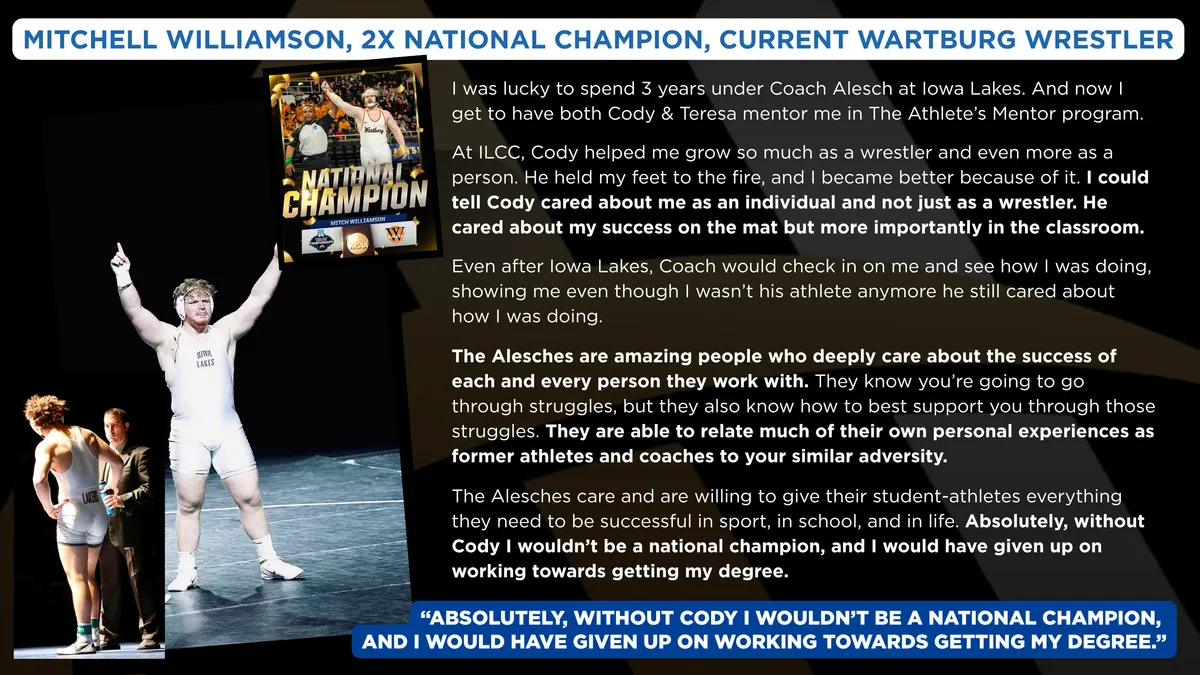
“Cody and Teresa were instrumental in guiding our students to create real change. We’re having our best school year so far in my 20-plus years here.”
Joe Wollum
Athletic Director & Student Leadership Advisor
"As a perfectionist, I used to struggle with mistakes derailing me. This program taught me how to keep my mindset in check so mistakes don’t derail me, and step out of my comfort zone to become a leader for my team. This applies far beyond athletics. I would recommend MMT to just about anybody."
Riley Meyer
High School Student-Athlete
"Every session with The Athlete's Mentor makes me a stronger, more focused leader. Their mentorship has helped me raise the bar and set higher expectations for myself. They fill a gap I didn't even know existed, and they do it by elevating your mindset and helping you lead with purpose."
Massoma Endene
3x National Champion
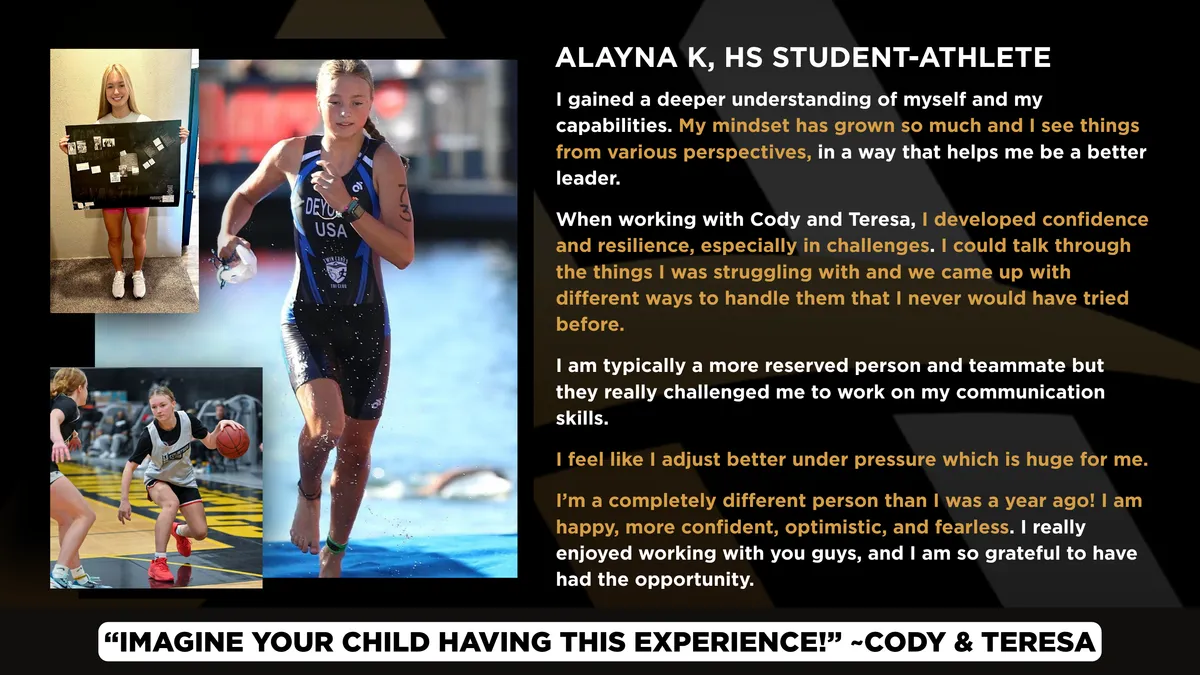
"I'm a completely different person than I was a year ago. My mindset has grown so much. As someone who is reserved, Cody and Teresa helped me grow my communication skills and pushed me to become a better leader. I adjust better under pressure now—which is huge for me. I'm more confident, optimistic, and fearless."
Alayna Kakacek
High School Student-Athlete
"When we started, I was scared. Boden was 17, graduating next year, and the direction he was heading was concerning. His grades were down, his attitude at home was a struggle, and he'd lost his self-drive. As a parent, you try everything, but sometimes you need another voice. That's where the program came in. I intentionally stepped back, because I realized the more I pushed, the more he resisted. I needed him to do this for himself.
The change was undeniable. His grades vastly improved. His overall attitude is just way better. He started doing things around the house without being asked, like clearing the table and doing the dishes—things that used to be a battle. He started reading and journaling on his own. He was taking initiative again. On the mound, you could see it. He was a different Boden. It's more than just the sport; it's his day-to-day decision-making, his structure, his control. I'm just so grateful. It honestly feels like I got my child back."
Kristal Luft
Boden's Mom
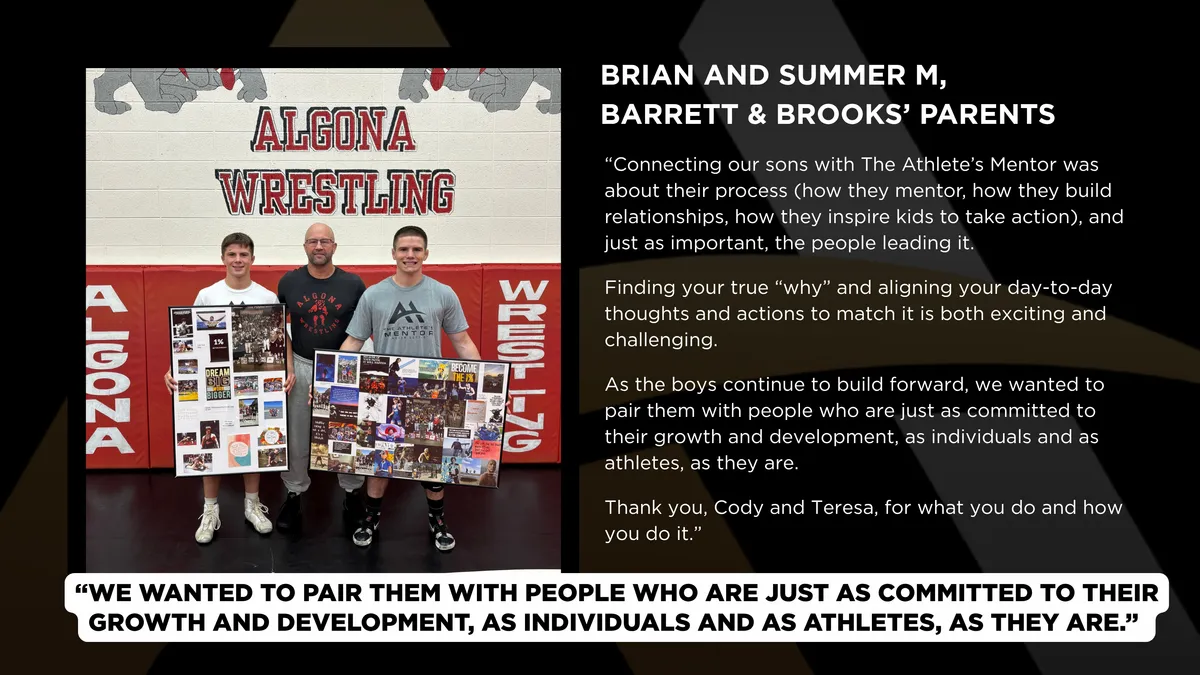
"2 of my children are currently attending Cody's & Teresa's leadership sessions. They encourage them to think about their role models and who they want to be: to their friends, to their family, their team, their community, their class, for themselves, etc.
Our kids leave these sessions and bring great conversation back to Mike and I. Watching our children grow into confident, kind, independent and fierce leaders is nothing short of amazing! I am a proud mama! A huge thank you to The Athlete's Mentor!"
Katie Soenen
Gwen & Cal's Mom






Partner Directly With
The Founders
A successful school initiative requires more than strong content. It requires partners who understand students, educators, families, school culture, and the difference between a promising idea and something a school can realistically implement.
Cody and Teresa bring complementary perspectives to that work—one shaped inside schools and one shaped through decades of coaching, mentorship, and leadership development.

Teresa Alesch
Educator · Administrator · Athletic Coach · Co-Founder
Teresa brings more than 20 years of experience across education, curriculum, coaching, and school leadership, earning recognition for excellence in both teaching and educational leadership.
She has served as a teacher, coach, curriculum leader, association president and chief negotiator, school principal, and regional administrator. Across those roles, she has remained focused on practical, real-world preparation—meeting students where they are without lowering expectations for where they can go.
Having sat on the school side of the table, Teresa understands staff capacity, competing priorities, initiative fatigue, and student-support responsibilities. That perspective helped shape MMT into a system educators can confidently facilitate within existing structures—without being asked to build another curriculum from scratch.

Cody Alesch
Athletic Coach · Mentor · Leadership Coach · Co-Founder
Cody brings more than 20 years of coaching and mentoring experience at the youth, high school, and collegiate levels, including national recognition from the NJCAA in 2021.
His work has centered on developing individuals, strengthening team culture, building accountable leaders, and guiding athletes through the pressure, setbacks, and daily decisions that shape performance and character. He understands the difference between hearing a good idea and being able to use it when the stakes feel real.
That experience helped shape MMT into more than motivational content. Cody translates mental toughness into practical language, useful tools, and repeatable actions—helping students take greater ownership of how they prepare, respond, communicate, and grow in school, activities, relationships, and life—long after the immediate challenge has passed.
"You get the founders - not a rotating consultant."
Together, Teresa and Cody bring more than 40 years of combined experience across education, coaching, school leadership, curriculum, mentorship, and family support. Schools work directly with the people who built MMT—and who remain involved in partnership planning, facilitator training, implementation check-ins, family engagement, and ongoing support.
START WITH STUDENTS
Start With Your Students
Build Implementation Around Them
Every school has its own students, schedules, priorities, staff capacity, family community, and existing support systems. An MMT partnership begins by understanding yours.
You do not need to have every implementation detail decided before beginning the conversation. Bring what you know about your students and what you hope to help them build. We will work through the rest together.
Which students or grade levels should begin
Where MMT can live within the school day
The pacing that best fits your schedule and goals
Who will facilitate and what preparation they need
How families will be informed, equipped, and invited to participate
How student progress and school-level growth will be measured
What a strong launch and successful first year should look like
Is this program only for student-athletes?
No. MMT was shaped through extensive work in athletics, where pressure, preparation, setbacks, and leadership are highly visible—but the system is built for students in every setting.
Lessons and workbook examples include academics, music, theater, student leadership, relationships, activities, and sports. Students choose the goals, situations, and applications that matter to them.
While rooted in championship-level sports psychology, Momentum Mental Toughness (MMT) principles apply to all students!
How much time does it require from our weekly schedule?
MMT can live within advisory, homeroom, seminar, leadership programming, activities, or a dedicated class. Schools may begin with one grade or cohort, serve multiple grades, or build toward a broader implementation.
The 37 videos contain under three hours of total video instruction, with core training videos averaging approximately 5½ minutes. Total program time depends on the time a school chooses to dedicate to workbook activities, reflection, discussion, and application. Components may be completed in class, independently, or through a blended approach.
Do our teachers need special training to facilitate?
No specialized psychological or coaching background is required.
We provide comprehensive facilitator guides, video assets, and structured resources so your educators can confidently lead discussions from day one.
The videos and workbook provide the primary instruction. Facilitators prepare for the lesson, set expectations, ask purposeful questions, clarify or re-teach tools when needed, correct misunderstandings, support practice, and help students connect the work to their lives.
How are parents integrated into the journey?
We believe in a holistic approach when possible.
Schools receive ready-to-send family emails that explain the experience, introduce the MMT language and tools, and help parents support the work without taking ownership away from their student.
Parents also receive practical resources and access to the MMT Parent Community. Schools may arrange an optional MMT Support from Home parent assembly led by Cody and Teresa.
How do we measure the program's success?
Students complete the MMT Performance Diagnostic and Momentum Scorecard at baseline, midpoint, and completion.
These structured self-assessment tools help students recognize changes across the four mental-toughness pillars of Control, Commitment, Challenge, and Confidence, along with seven Mission-aligned areas: Awareness, Focus, Direction, Purpose, Resilience, Confidence, and Leadership.
Students receive an individual Baseline Snapshot, Mid-Journey Checkpoint, and final Growth Report, while school leaders receive aggregate school-level reporting.
The purpose is to make student-reported development visible and create better reflection and coaching conversations—not to label students or reduce growth to a single score.
Does this replace our existing mental health resources?
No. MMT is an educational, mentorship-based self-leadership system. It does not diagnose or treat mental-health conditions and does not replace counseling, special education, medical care, or other professional support.
Schools continue using their established student-support, privacy, safeguarding, and family-communication procedures. MMT gives facilitators clear boundaries and guidance for connecting students with the appropriate school support when needed.
CLARITY & CONFIDENCE
Frequently Asked Questions
We’ve structured our curriculum to integrate seamlessly into your school's existing rhythm—without adding friction, burden, or guesswork for your staff.
START THE CONVERSATION
Bring MMT To Your School
Create more than a successful program. Help students build a system for leading themselves.
MMT gives schools a practical way to turn self-leadership from something adults hope students develop into something students intentionally learn, practice, and own. If that reflects what you want for your students, let’s begin with a conversation about your school, your goals, and what an MMT partnership could make possible.
Explore an MMT School Partnership: Book a call below, or reach out at [email protected].


The Athlete's Mentor | Never Settle
© 2026 The Athlete's Mentor. All Rights Reserved.